

Headlines regularly claim that Japan is giving away houses for free. What's the catch?
Japan's akiya (abandoned houses) can cost close to nothing to buy, but they are rarely free to own and come with hurdles for anyone buying them for rental income.
In a nutshell:
- Most need heavy renovation paid in cash.
- Short-term rentals are capped at 180 nights a year unless specific licences are obtained.
- Resale demand in rural towns is thin.
As a holiday home, an akiya could still make sense.
This guide draws on a property-viewing trip to Japan by Han and Tracy, the founders of Byte Sized Investments (BSI), who met a local agent and contractors while assessing akiya as an investment.
What is an akiya?
An akiya is a vacant house in Japan. The word literally means "empty house".
Japan had a record 9 million vacant homes in 2023, about 13.8% of all housing, according to the government's Housing and Land Survey. About 3.85 million of them have no plan to be rented or sold at all.
They pile up for a few common reasons:
- An ageing, shrinking population. Owners move into care or pass away, and there is often no one who wants to inherit the house.
- A preference for new homes. Japanese buyers favour new builds in the cities, especially with older homes not being built up to the latest earthquake codes. Older houses lose their value, and often only the land is worth anything.
- Holding costs. An owner who cannot sell keeps paying property tax, which is why some akiya are offered for ¥0 or ¥1.
Can foreigners buy an akiya in Japan?
Yes. Japan does not restrict foreigners from buying houses or land, and buyers do not need to live in Japan.
There are two catches. Owning a house in Japan does not come with a visa to live there. And if the land is classified as farmland, the local agricultural committee has to approve the buyer, which in practice usually means showing the land will be farmed.
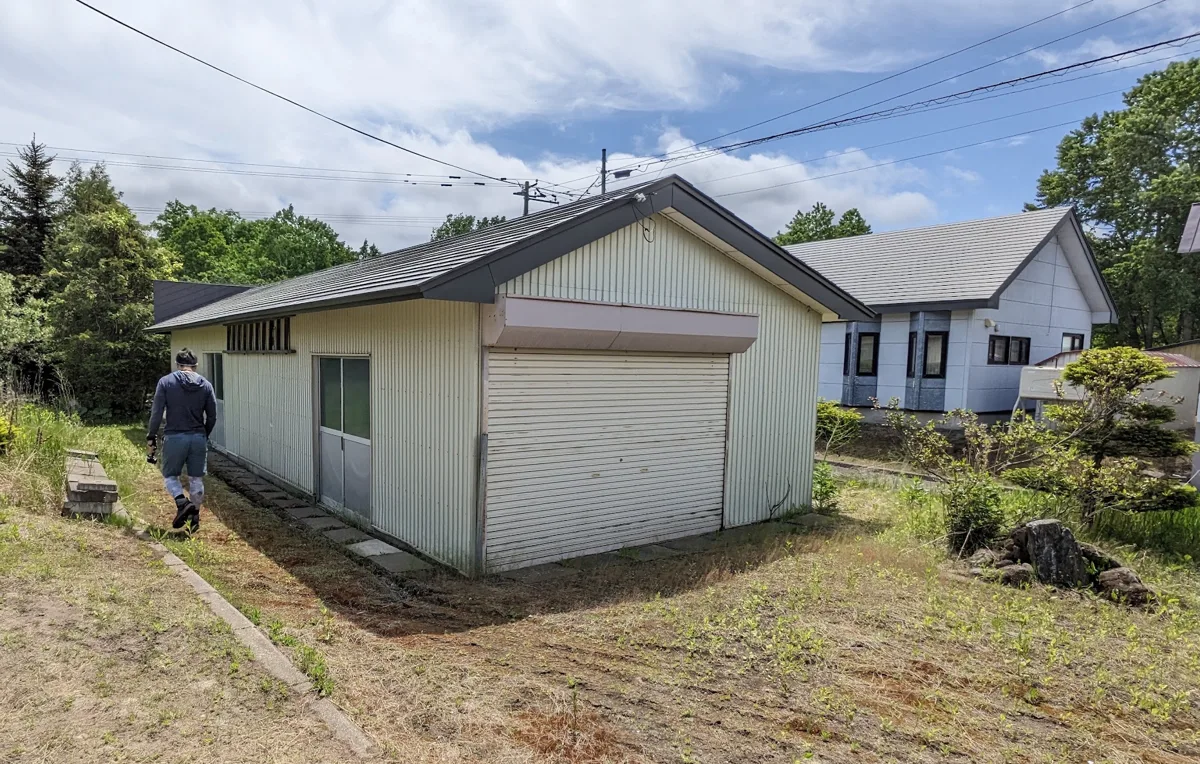
Han of Byte Sized Investments viewing an akiya in Hokkaido.
How much does a "free" akiya really cost?
The house might be free, but making it liveable is not.
Here is the price tag on a "free" house in Hokkaido, based on quotes from local contractors during BSI's trip:
| Item | Typical finding |
|---|---|
| House | ~S$0 |
| Renovation | ~S$200,000 for a 1,500 sq ft house |
| Utilities | Often extra: many had no water or electricity connected |
| Loan | Rarely available, so usually paid in cash |
| Taxes and fees | Registration tax and property acquisition tax on top |
| Short-term rental | Capped at 180 nights a year without a hotel licence |
The houses mostly need a lot of renovation as they are 45 to 70 years old, which means they were built before Japan's stricter earthquake code took effect in June 1981.
Any structural change needs a permit, and a permit needs the building brought up to today's code. According to the local contractors consulted, a lot of the house typically has to be torn down and rebuilt to get there. So the renovation bill is very hard to avoid.
Can you get a loan to buy or renovate an akiya?
Usually not. It is very difficult for foreigners to get a mortgage in Japan, and Japanese banks generally want residency or Japanese income before they lend.
Almost no lender will fund the renovation of an old, remote house either. In practice, both the purchase and the renovation come out of the buyer's own pocket.
Can you rent out an akiya on Airbnb?
Yes, but only for up to 180 nights a year. Japan's Private Lodging Business Act caps short-term rentals (minpaku) at 180 days a year, and owners must report their nights to the authorities, according to the Japan Tourism Agency.
That is over 50% vacancy built in from day one. Some local governments set tighter limits on top of the national cap.
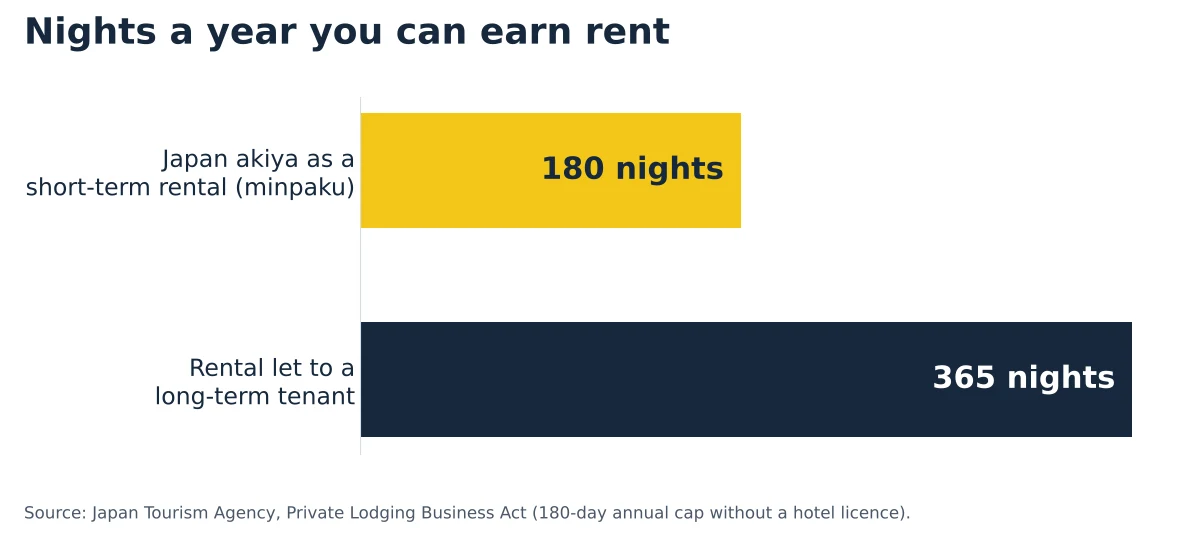
A minpaku can earn on at most 180 nights a year. A long-term tenant pays rent all year, but long-term rental demand in the rural areas where most akiya are is likely to be low, rents there are usually low too and may not meet your target returns, and a house rented out all year cannot double as your holiday home.
Renting short-term all year requires a hotel or inn licence instead. That brings zoning, facility and fire safety requirements, which cost more money and time.
On top of that, having a short-term rental manager in Japan is compulsory for non-residents, and they typically take 20 to 30% of the rent, which cuts cashflow further.
Can you sell an akiya later?
Yes, but it can be hard. Demand is thin in a rural village where houses are being given away.
The houses on the BSI viewing trip had been on the market for years. In Japan, a building's value falls steeply with age, and in rural areas the land itself rises very slowly, if at all. A cautious plan assumes the exit price could be close to zero.
Is an akiya a good investment?
For most investors seeking rental income, the numbers are difficult. The main hurdles:
- Large cash outlay for renovation, with no loan to spread it.
- Capped income: 180 nights a year for a short-term rental, minus a 20 to 30% management cut.
- Weak exit: falling building value and few buyers.
An akiya can still make sense when:
- The goal is a holiday home in an area you love, treated as a lifestyle cost rather than an investment.
- You plan to relocate to Japan, live in part of the house and rent out the rest for some pocket money.
- The numbers still make sense even after all the abovementioned considerations, and you have a translator or bilingual agent to deal with contractors and city hall.
Before buying, check whether the land is farmland, whether utilities are connected, what the zoning allows, and get a seismic check on the building.
Akiya vs US rental property for overseas investing
Han and Tracy chose to invest in the US instead of Japan when comparing overseas property investment. Here's a quick comparison.
| Japan akiya | US rental property | |
|---|---|---|
| Loans for foreigners | Rarely available | Available, e.g. DSCR loans based on the property's rent |
| Renting restrictions | 180 nights a year as a short-term rental | No national cap. All year to long-term tenants (some cities limit short-term rentals) |
| Selling and exit | Few buyers in rural towns | Active resale market in many US cities |
Read more in this 6-point analysis of why to invest in US real estate.
Summary: Is buying an akiya a good investment?
For rental income it is usually difficult: it needs cash for renovation, rental nights are capped, and resale is hard. It can however work as a holiday home or for someone planning to live in Japan.
The akiya viewing trip is also shown in this short video: