


No US credit score, no Social Security number, no US income and no US address. So can foreigners get a US mortgage to buy property?
Yes. A normal home loan is approved on the borrower’s salary, because the salary is required to repay it. In the US, foreigners can instead use a Debt Service Coverage Ratio (DSCR) loan, which is approved on the property’s rent instead. If the rent covers the monthly mortgage payment (PITI: principal, interest, property taxes and insurance), the lender does not need to check the borrower’s salary.
Getting approved is only half the job: the closing package runs to over 100 pages, and it has to be signed and notarised from outside the US. This guide will run through the different loan types and closing processes as a foreigner from outside the US, without needing to fly or step foot into the US.
In a nutshell:
- A DSCR loan is the usual US mortgage for foreigners. The lender checks whether the rent covers the mortgage, not your income.
- The same loan type works for buying a property and for a cash-out refinance of one you already own.
- Closing can be done without travelling to the US: by remote online notary, apostille or a US embassy appointment.
Can foreigners get a US mortgage?
Yes, but usually not a conventional one. Conventional US mortgages are built around US income, US tax returns and a US credit history, which most overseas investors do not have.
Instead, foreign investors use a DSCR loan from lenders that specialise in investment property.
What is a DSCR loan?
A DSCR (debt service coverage ratio) loan is an asset-based loan for property investors. The lender does not ask about your salary or which country you live in. It asks one question: does the property earn enough rent to pay its own mortgage?
Two consequences surprise many Singapore investors:
- No income-based cap on total borrowing. Each property only has to carry its own loan, so there is no equivalent of Singapore's Total Debt Servicing Ratio (TDSR), which limits total monthly debt repayments to a percentage of income. An investor can hold several DSCR loans as long as each property covers its own.
- Age is usually not a barrier. Because approval rests on the property, not the person borrowing, lenders do not apply an upper age limit, so a 30-year loan is possible even for an older borrower regardless of age.
Down payments, interest rates and minimum loan sizes vary by lender, and DSCR rates are usually higher than conventional mortgage rates. Compare several lenders, and check your own situation with a qualified professional.
How do lenders calculate DSCR?
Lenders divide the monthly rent by the monthly PITI: principal, interest, property taxes and insurance (landlord insurance). Most look for a ratio of at least about 1.0 to 1.2, meaning the rent covers the whole payment, ideally with a buffer.
| Example | Monthly rent | Monthly PITI | Ratio | Likely outcome |
|---|---|---|---|---|
| House A | US$1,200 | US$1,000 | 1.2 | Likely approved: the rent covers the payment with a buffer |
| House B | US$800 | US$1,000 | 0.8 | Likely declined: the rent falls short of the payment |
These are illustrations. Each lender sets its own minimum ratio, and a higher ratio can earn better terms.
How is a purchase loan different from a cash-out refinance?
Both use DSCR loans, but the steps differ. A purchase loan is for a property you are buying. A cash-out refinance lets you borrow against the value of a property you already own.
Purchase loan. Start with a pre-approval letter before making offers. It tells sellers the buyer has a loan lined up and cash for the down payment. To get one, lenders generally ask for a valid passport and two to three months of bank statements showing the down payment plus reserves of at least three to six months of mortgage payments.
Cash-out refinance. This applies to a property you already own, and replaces or adds a loan based on what the property is worth today, not what was paid for it, so the equity gained can be drawn out without selling. There is no seller, so no pre-approval letter is needed. Lenders look at seasoning instead: most want the property owned for at least six months and rented out (i.e. income generating) before they will refinance it.
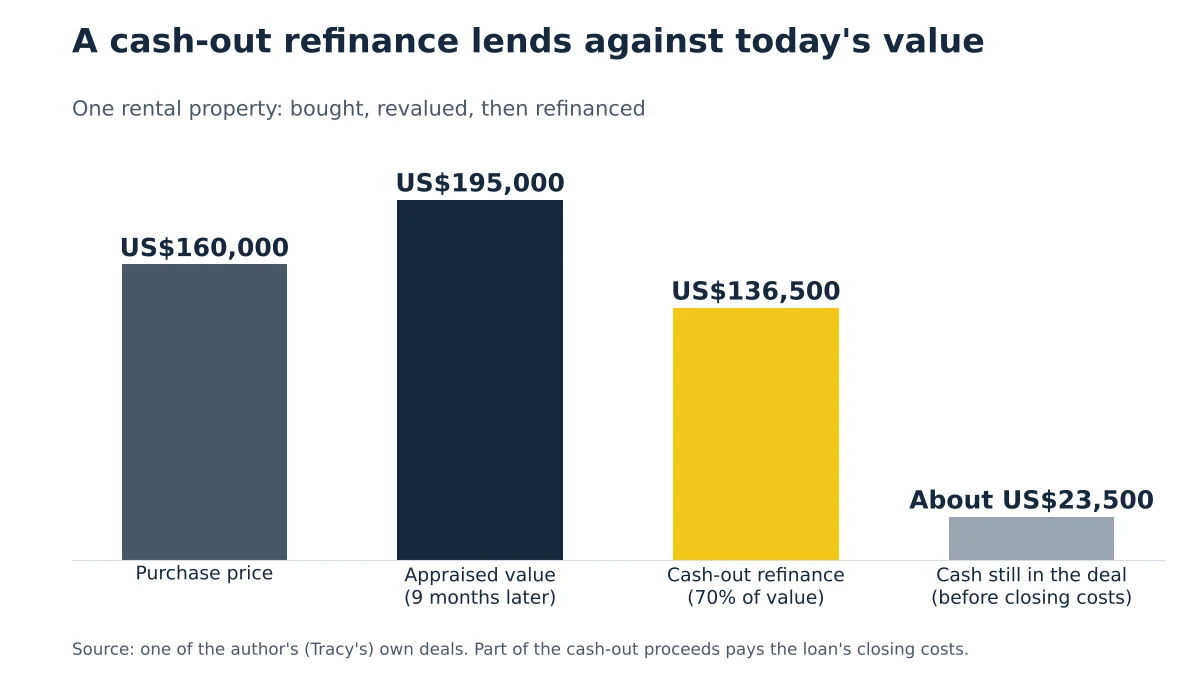
In one of the author's own deals, a rental property bought for US$160,000 was appraised at US$195,000 nine months later. A cash-out refinance at 70% of the new value raised US$136,500, so only about US$23,500 of the original purchase price was still tied up in the property. But part of the cash-out proceeds goes to the new loan's closing costs, and the bigger loan means a bigger monthly payment that the rent still has to cover.
What is in a US loan closing package?
Expect more than 100 pages: the settlement statement, the loan documents, the mortgage or security deed, and a set of affidavits and declarations.
The closing package will be similar but unique to every lender. Ask the lender and title company for the package at least a week before closing, so there is time to read it. Some forms are standard and cannot be changed, but the loan terms, closing fees, lender fees and escrow amounts should all be checked before signing. Closing and lender fees are shown on the settlement statement and, in the author’s experience, usually come to about 3 to 5% of the loan amount.
How can you sign US mortgage documents from overseas?
There are three ways. Which ones are open to you depends on what your lender and title company accept, so ask in this order.
| Option | How it works | Typical cost | Main drawback |
|---|---|---|---|
| 1. Remote online notarisation (RON) (preferred, easiest and cheapest) | The title company books a US online notary. You verify your identity and sign digitally on a secure video call. | A few hundred US dollars | Not every lender or title company accepts it |
| 2. Apostille (middle ground) | Sign in front of a local notary public, then get an apostille certificate from your country's authority (in Singapore, the Singapore Academy of Law). Send the hardcopy signed package to the US title company (e.g. via DHL overnight service) | About US$400 to US$700 per set of closing documents, depending on the lawyer | Only for countries in the Hague Apostille Convention, and not every lender accepts it |
| 3. US embassy (most tedious, most expensive) | Print the package, book a notarial appointment with the US Embassy in your country, and sign in front of a US consular officer. Send the hardcopy signed package to the US title company (e.g. via DHL overnight service) | In Singapore, this currently costs US$50 per signature/seal. With 15 to 20 seals per package, plus overnight courier to the US, often over US$1,000 | Tedious, expensive, and US Embassy appointments can be booked out for weeks |
Remote online notarisation is the fastest and cheapest. It saves printing, signing on paper, finding a notary, and overseas shipping, so ask for it first.
An apostille is the middle ground. A local notary public (in Singapore, a lawyer appointed as a notary) witnesses the signing, and the apostille certificate proves that notary is genuine to every other member country. Singapore joined the Hague Apostille Convention on 16 September 2021, and the Singapore Academy of Law issues its apostilles. Australia and the UK are members too.
The US embassy is the traditional route and the one most lenders accept, but it is the slowest and most expensive. If closing is next week and the embassy is booked out for a month, the deal is at risk. Book the appointment early and always remind the lender and title company upfront about this timing consideration.
Summary: Can foreigners get a US mortgage?
Yes. Foreign investors use a DSCR loan, which is approved on whether the property's rent covers the mortgage, for both purchases and cash-out refinances. Plan the closing early: communicate on the closing mechanics with your lender and title company upfront, request the documents a week ahead, ask for a remote online notary first, then an apostille, and keep the US embassy as the last resort.
Every step, from approval to remote signing, is also walked through in this video:
Ownership, LLCs, taxes and the other questions foreigners ask before buying are covered in the guide to buying US property as a foreigner.