
To international property investors, the US real estate market can appear complex and inaccessible. However, the US market remains one of the most opportunity-rich environments for those who understand how to navigate the legal and financial landscape remotely.
Building a resilient, dollar-denominated portfolio requires moving past "hope-based" appreciation and focusing on repeatable systems. This guide addresses the most critical questions international investors face when entering the US market, focusing on asset protection, financing, and operational scalability.
1. Legal Ownership Rights for Non-US Citizens
The United States maintains an open-door policy regarding real estate, allowing for 100% freehold ownership by foreigners. You do not require a Green Card, US citizenship, or a local partner to acquire property. Ownership can be held in your personal name or through a US entity, such as an LLC, both of which provide full legal title and protection under US property law.
2. The Strategic Role of the Limited Liability Company (LLC)
For the professional investor, an LLC is the standard vehicle for risk containment. The US is a litigious market; an LLC serves as a corporate veil, generally ensuring that any liability arising from the property (such as tenant disputes or accidents) is limited to the assets held within that specific entity. While some begin in their personal name for a single property, scaling a portfolio necessitates an LLC to protect personal global assets and provide a professional structure for tax reporting. However, it is important to note that an LLC does not act as a replacement for landlord insurance, nor does it act as a "magic shield" against all legal proceedings.
3. Executing Remote Acquisitions and Closings
Technological infrastructure in the US real estate industry allows for 100% remote transactions. Cash Purchases are typically handled via digital signatures and secure wire transfers to a licensed Title Company. For Financed Purchases, lenders often require a physical notary; international investors manage this through a local notary in their home country, a remote online notary, or a scheduled appointment at the US Embassy. The requirements vary for different lenders and different title companies, so it is important to check with them upfront on their loan closing requirements for foreigners.
4. Capital Requirements and Entry Points
Unlike the homogeneous pricing seen in markets like Singapore, the US market is filled with pricing inefficiencies. Entry points for freehold, landed property are significantly lower than in most global hubs. It is possible to identify high-yield, single-family homes in stable markets for under $150,000. These low entry points allow investors to achieve diversification across multiple properties with the same capital required for a single down payment in a major Asian or European city.
5. Accessing US Financing (DSCR Loans)
Financing is a primary engine for scaling a remote portfolio. International investors have access to DSCR (Debt Service Coverage Ratio) loans. Unlike traditional loans that rely on personal income or employment history (TDSR), DSCR loans are approved based on the property’s ability to generate enough rent to cover the mortgage and expenses. This allows investors to bypass requirements for personal credit, personal income, and even age limits, and focus strictly on the asset's performance.
6. Taxation and the "Depreciation" Shield
The US tax code is highly favorable to real estate owners. The primary advantage is depreciation, a non-cash expense that allows you to write off a portion of the building's value every year against your rental income. When structured correctly by a specialized CPA, this "paper loss" can reduce your effective tax liability on rental profits to near zero, making real estate one of the most tax-efficient businesses in the US.
7. Capital Repatriation and Outflow
The US maintains an open economy with no capital controls. Investors can move rental profits or capital gains back to their home countries easily. Utilizing modern banking platforms, like Wise, allows for seamless transfers from US business accounts to local accounts with minimal fees. However, the specific structure of these transfers should always be guided by your tax and legal strategy.
8. Remote Property Management Infrastructure
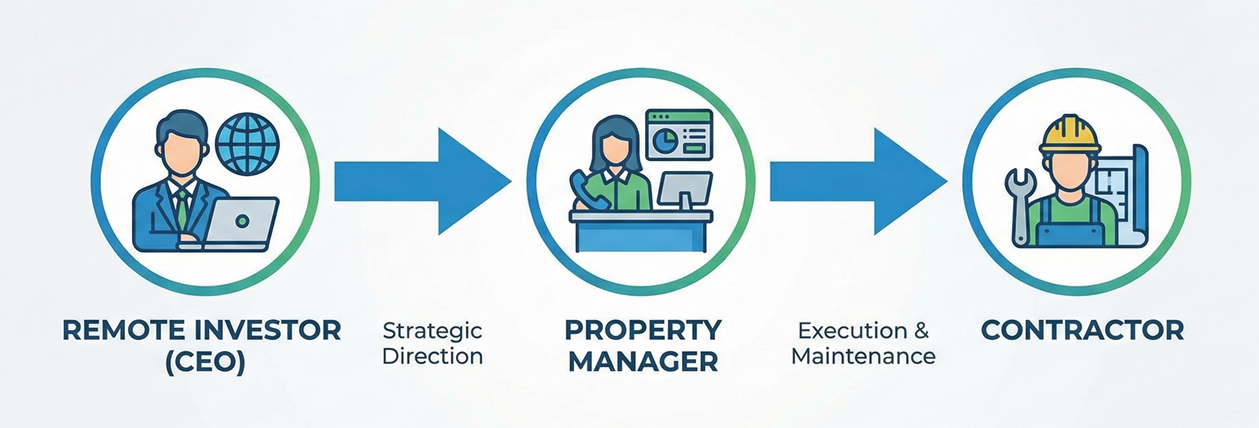
Operational success in remote investing depends on the "CEO Mindset." You are not a landlord; you are a business owner managing a Core Team. A professional Property Manager acts as your local representative, handling tenant placement, maintenance, and legal compliance. Your role is to monitor the performance of the manager and the asset, not to handle the day-to-day logistics.
9. Market Volatility and Economy Downturns
Two structural factors protect the long-term US real estate investor during economic turmoil: No Margin Calls and Recession-Resistant Demand. US mortgages are typically structured such that banks cannot demand additional capital if property values fall, provided the mortgage is paid. Furthermore, by buying for cash flow rather than speculative appreciation, and by renting properties to the middle-class which makes up the majority of the population, the property remains self-sustaining regardless of market cycles.
10. The Value of a Proven Blueprint for Foreigners
While information is abundant online, it is rarely tailored to the specific friction points faced by non-US residents. International investors often encounter hurdles with Title Companies, Lenders, and Realtors who are unfamiliar with foreign-national closings. Utilizing a proven system is a strategic move to bypass the "trial and error" phase that can cost investors tens of thousands in avoidable mistakes.
The US market rewards those who act on data rather than speculation. If you are ready to build a scalable, dollar-denominated rental portfolio using a repeatable system, start with our foundational training.
👉 Access our Free Introductory Course on Remote US Real Estate Investing
