


Headlines regularly warn that the US dollar is collapsing. What does that mean for someone who owns, or plans to buy, US property?
While the US dollar is weaker against the Singapore dollar than a few years ago, it is not collapsing: it still makes up over half of the world's central bank reserves, and its index is higher than at the end of 2025.
For an overseas investor who owns US property, the exchange rate matters at only two moments: when money goes into the US and when it comes back out. Rent, the loan and the house's value are all in US dollars, and the exchange rate does not change any of them in dollar terms.
This guide runs through what a weaker US dollar does, and does not do, to the rent, the mortgage and the value of a US property held from overseas.
Is the US dollar collapsing in 2026?
The data points to a gradual weakening against some currencies, not a collapse. Three numbers, all as of October 2026:
- Against the Singapore dollar: US$1 bought S$1.278 on 23 October 2026, compared with S$1.299 a year earlier, a fall of about 1.6%, according to Federal Reserve H.10 data.
- Against a basket of major currencies: the US Dollar Index (DXY) closed at 101.81 in the week to 23 October 2026, up from around 97.80 in late December 2025, so the index has actually risen in 2026.
- As a reserve currency: the US dollar made up 56.70% of the world's allocated foreign exchange reserves in the second quarter of 2026, against 20.60% for the euro and 2.11% for the Chinese renminbi, according to the IMF's September 2026 data brief. The dollar's share edged down from 57.18% the quarter before.
A slow slide in reserve share and a weaker rate against the Singapore dollar are real trends. A collapse would look very different: a currency losing a large part of its value in a short time. That is not what the data shows.
Why has USD to SGD been falling?
A large part of the story is the Singapore dollar's strength, not only the US dollar's weakness.
The Monetary Authority of Singapore (MAS) manages the Singapore dollar against a basket of trading partners' currencies rather than by setting interest rates, and its record of policy decisions shows a long-standing preference for a gradually stronger Singapore dollar to keep imported inflation down.
In October 2026, MAS held its policy settings steady.
Over two decades, the effect is clear. US$1 bought an average of S$1.79 in 2002 and S$1.31 in 2025, based on the Federal Reserve's G.5A annual averages.
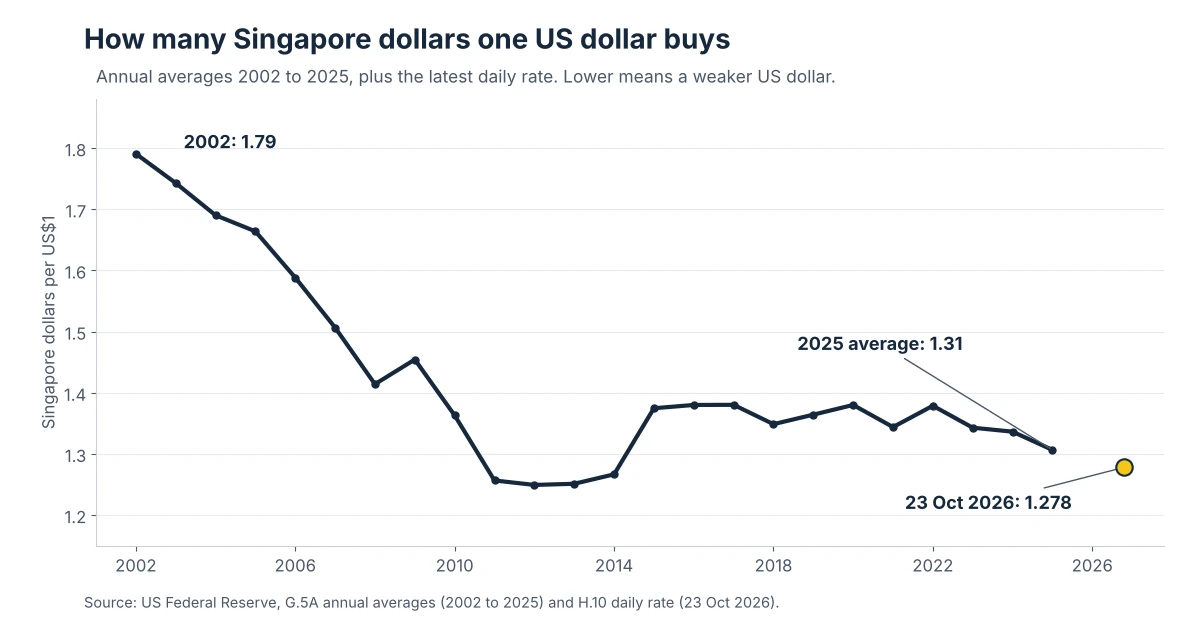
Singapore dollars per US dollar, annual averages 2002 to 2025 and the latest daily rate (23 October 2026). Source: US Federal Reserve.
Two points stand out on the chart. The long-run trend has favoured the Singapore dollar. And today's rate is not a record: US$1 averaged about S$1.25 in 2011 to 2013, before the US dollar strengthened again from 2015.
Does a weaker US dollar affect US rental income?
Not in US dollars. A tenant pays the same US$ rent whatever the exchange rate does, because the rent is set by local wages and local supply of homes, not by currency markets.
Over time, the bigger driver of rental income has been rent growth in US dollars. US rents, as measured by the consumer price index for rent of a primary residence, have risen steadily for decades, with only brief pauses.
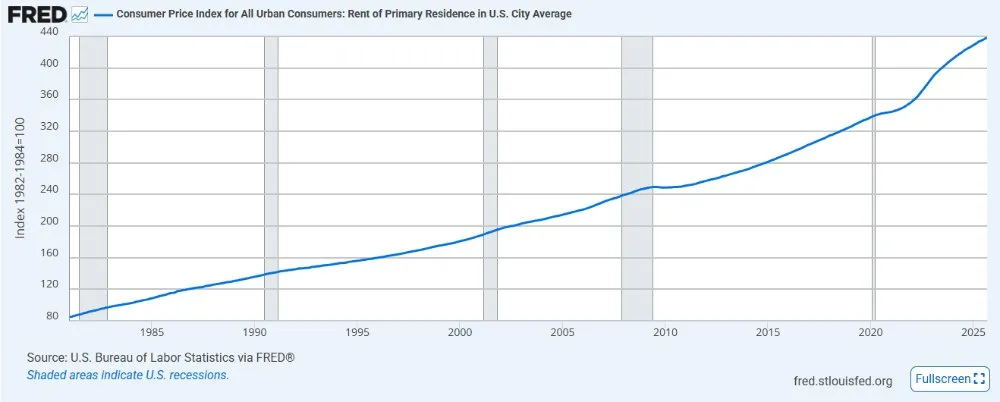
US rent index (CPI, rent of primary residence, US city average), 1981 to 2025. Source: US Bureau of Labor Statistics via FRED.
Does a weaker dollar change the mortgage on a US property?
Not if the loan is in US dollars. A US mortgage is borrowed and repaid in US dollars, and it is paid from US dollar rent, so the currency in and the currency out match.
What does move loan costs is US interest rates. On 28 October 2026, the Federal Reserve held its policy rate at 3.75% to 4%, in a 10 to 2 vote; the two dissenters preferred a quarter-point increase, and the statement noted that inflation "remains elevated". For an owner already on a fixed-rate loan, this changes nothing on the monthly payment. It matters for new purchases and refinancing.
The picture changes if the money is borrowed in one currency and earned in another, for example a loan taken in Singapore dollars to buy a house that earns US dollar rent. That creates a currency mismatch. Investors commonly prefer to match the loan currency to the rent currency for this reason, but the right structure depends on personal circumstances, so check with a qualified professional.
What happens to US house values when the dollar weakens?
In US dollars, nothing directly. House prices in a US town are set by local buyers, local incomes and mortgage rates, not by the US$/S$ rate. The FHFA House Price Index, released on 27 October 2026, shows US house prices up 2.4% in the 12 months to August 2026.
The currency effect appears only when a value is converted back to S$. Always keep sufficient reserves in your home currency for daily expenditure and emergencies, and invest only with money you don’t need back in the near future. That will allow you to leave your money in US dollars without being forced to convert at a bad exchange rate.
Where a weaker dollar has no impact, and where it does
For an overseas landlord, the effects split cleanly:
| Item | Effect of a weaker US dollar |
|---|---|
| Rent paid by the tenant (US$) | No impact |
| Fixed-rate US$ mortgage payment | No impact |
| Property tax, insurance, repairs (US$) | No impact in US$ |
| Tenant demand and vacancy | No direct impact; driven by local jobs and housing supply |
| House value in US$ | No direct impact |
| Profits kept in US$ and reinvested in the US | No impact until converted |
| Buying with S$ converted to US$ | Helps: each S$ buys more |
| Rent or sale proceeds converted back to S$ | Hurts: fewer S$ per US$ |
A weaker dollar can also travel with other changes, such as higher US inflation or a different path for interest rates. Those can affect rents, house prices and loan costs in US dollars, in either direction. Nobody can reliably predict which, so a plan should hold up under a range of exchange rates rather than depend on one forecast.
How do overseas investors manage currency risk on US property?
Practitioners commonly use a few simple habits rather than trying to time the rate:
- Match the currencies. US$ rent pays a US$ loan and US$ expenses, so the property runs in one currency.
- Convert only what is needed. Income that will be reinvested in the US can stay in US dollars, so it is never exposed to the conversion.
- Spread conversions over time. Converting in several smaller amounts avoids betting everything on one day's rate.
- Judge the deal in US dollars first. A property that does not work in US dollars will not be rescued by the exchange rate.
Formal hedging products exist too, but they cost money and add complexity. This is general information, not financial advice: check your own situation with a qualified professional.
Summary: Is the US dollar collapsing?
The US dollar is weaker against the Singapore dollar than it was a few years ago, but it is not collapsing.
For a US property owner, rent, the loan and the house value all stay in US dollars. The exchange rate only matters on the way in and the way out.
The practical side of owning US property from overseas is covered in this guide to investing in US real estate as a foreigner.